

Rich Huxley on art, community and music
tbd
JA: Well, thank you for being here.
RH: Nice! Nice to see ya!
JA: And you! Excellent.
JA: You might know that, my day job is to help visual artists promote their work and sell their work. So I'm a marketing guy for artists and so I have this thing called the Art Stepper, and it's supposed to be a monthly magazine, but I haven't done it for the last few… last couple of months because of useless reasons and so you're rescuing me at present by being my interviewee.
RH: hopefully I'll be useful, or at the very least, delightful, if I can't be useful.
JA: So, part of the reason why I thought you'd be good to talk to. Two things, really. A lot of the work I do centres on values what actual values are you trying to live by? And Hope and Social have always been really strong at that. So that was kind of why I wanted to talk to you. But also, you are a lot more artistic, you include the arts in a much broader sense than just being a band. So you’re on a creative journey which might be .. what's the word? Analogous? To how a visual artist might develop their career. So you are a big part of Hope and Social. So you'd better tell us who Hope & Social is, and who the hell you are. Anyway. Hello, Rich.
RH: Well, I'm a physically small part. So Hope & Social is a band based in Leeds, UK. We like to do all the things that bands do, and then some other things as well. When we set up Hope and Social, we were always the kind of people that, post gig, everyone back to ours. That was… that was the kind of vibe. And there was a period when, pre-Hope & Social, we were possibly trying to chase the classic, you know, artistic dream of being the next U2 or whatever. But coming out of that, we had a two-point manifesto in the early days, and the two-point manifesto was, we should only do things that are fun, that we want to do, because we had been doing things that we thought might be good for our career and the other one was no love songs, which we have reneged on. But that said, it has been 17 years of being Hope & Social. So, I think it's fair to change and shift your goals as your lives and careers develop.
RH: We were a band called Four Day Hombre, and we definitely kind of chased the classic old-school music industry kind of dream of, you know. We moved to Leeds in ‘98, we were like, yeah, we'll write some songs, we'll send them in, we'll get a record deal. It'll be easy, and if that doesn't work, you know, we can chuck it all in by the age of 25. And I turn 50 in about 20 days
JA: That's impossible!
RH: Yeah, there's a knot at the back of my head pulling everything into shape. So, we wanted to involve people in what we do. When we could afford to, we did a bunch of living room gigs. We made everything pay what you want. We wanted there to be a zero barrier to having our music because as soon as it's released, you know, anyone can get it anyway, so why put a barrier there? The problem for the majority of musical artists is not scarcity. As soon as something is digitally available, it's reprintable at zero cost anywhere around the globe. So, the problem is being in front of the people, so we wanted to remove all those barriers. We did a lot of stuff for nothing. We did a lot of stuff, pay what you want, house gigs were always on that basis. We just wanted to build a community one by one and develop relationships with fans. The opposite of what the classic music industry does, which is, here is artist. Here is market. And then in the middle will sit all our cultural intermediaries. All the press people, all the pluggers, all the PRs. All the radio presenters, God love them, I know loads, and a lot of them are great, but, you know, people who can essentially decide whether you are heard by people or not.
RH: And through conversations with wonderful people such as Andrew Dubber, Steve Lawson, Laura Kidd, all of whom I've done work with for, um, New Musical Strategies, is that what it was called? I think it was. Yeah, we built a community of people who want to have a relationship with us, who want to sustain our art making, and who want to… One of my favourite examples of this, we did a gig at Unconvention in Manchester. Unconvention's a great, kind of, anti-conference for music things. And we played at one of them. And at the end of it we would go around with our ice cream tray of merchandise. And one guy came up, he's like, “what can I get with 20 quid?” And I was like, well, we've got things, you can have the things. And he was like, oh, great. So I gave him the things, and he was like, is that enough? I was like, yeah, it's pay what you want for this reason. And just so you know, we've got, like, other things available on Bandcamp, also pay what you want. And he was like. “Oh, great! Well, to be fair, I was only gonna rip them anyway, but if I can get the downloads, you can have the CDs”. I was like, oh, thanks here's your money back. And he's like, “no, no, I want you to have the money”. So, we… we started building stuff like that, really.
RH: I think a testament to our decision-making thus far is we became Hope and Social and yeah, we're still going. It's still a sustainable thing. We are unbeholden to anyone. We can do whatever we want, we can make whatever music we want, we can put on silly events, we can put on beautiful, elegant Christmas parties, we can do a night where we only play toy instruments. We can do whatever we want. And no one can stop us. And it pays us some money.
JA: That's actually part of the thing that visual artists have a problem with, you know, you kind of develop a visual style. Everybody in the industry says you've got to develop a visual style, so when somebody walks into a room and they see your painting, they know it's you. And so that's kind of goal number one. And then it feels constraining, whereas you just… obviously, you've got your songs, you've got to play the songs but other than that, the freedom kind of comes through really, really nicely, and…
JA: Was it our first encounter when you had a friend who had a really nice house and a big garden, and it was like a summer party thing, and
RH: Was that the first time that you came to one of our things?
JA: I don't know. It could have been, but it was the garden party, wasn't it?
RH: Yeah, about 2010, maybe.
JA: And should I tell you the best bit about that?
RH: Go on. Yeah, tell, I'm always keen to hear where I was great.
JA: I sat under a mulberry bush and ate a mulberry, and it was gorgeous.
RH: Fantastic. I'll take that. We orchestrated that.

Rich Huxley, Jo Cox Photography
JA: Yeah. You brought the manure in so that it was, no, it was a, it was a proper event. You had friends in support, silent disco, and all that kind of stuff, and it was amazing. It was a beautiful first introduction to you.
RH: I think one of my favorite ones on that was we had a treasure hunt, which was kinda mainly for kids, but also for adults. And if you followed the treasure hunt, you ended up in, it was Ange in Murfield, it was her and Gordon's house, beautiful house. And you ended up in their shed. Which we'd clad in black cloth. And James, bless him, had made a music box that would play one of our songs.
JA: Wow.
RH: The song was called Sleep Sound, and there was a projection of the night sky on the ceiling. I think that was one of my favorite little…
JA: Oh, my goodness.
RH: Delighters, if you… I like the idea of delighters, like, little surprises that not everyone necessarily finds.
JA: That’s super. And no I didn't see that. And you also sent out, like, air drying clay, and made everybody make blackbirds, and then we had to hang them on some message thing, and we… I remember us sitting and doing that.
RH: Yeah, it feels almost like being in education, doesn't it? We have high expectations of our audience.
JA: But it's, I mean, genuinely beautiful. You don't get that at a normal gig, it's just… it's just absolutely super.
RH: Yeah, you don't get that at Coldplay, do you?
JA: Yeah, so I gave AI your website and asked it to work out your values and it came up with “art as a shared act of community joy”.
RH: Ooh, yeah, that seems pretty on-brand, I would say. Yeah, like, one of our mottos. And hats off to the amazing Ben Dennison on this. I think this started, actually, when we were planning the garden party “have fun make art”. That was definitely a central tenet of our approach to things. So we even raised, I don't know if you partook of this, there were little stations where people could decorate the letters that made up Have Fun, Make Art. And then, towards the end of the garden party, we hoisted that as a giant mobile. So they're, like, white letters.
JA: God, I remember that, that was quite dangerous.
RH: Yes!
JA: There was that, and there was also hitting a thing containing things.
RH: Paintball… paintball swing ball.
JA: Yeah it was all… it was all dangerous, really.
RH: Yeah, I would say the larger, more complicated our events have go, we've definitely invoked some stricter health and safety. Like, at the garden party, we didn't even have, like, the stage wasn't covered, so. We did have plans in place for if it did rain, but… Yeah, definitely a little sketchier in our earlier careers.
JA: But now, now you're more professional.
RH: Yeah, there's a whole bunch of us who've got kids, so, you know, we need to stop anything that might be litigious.
JA: And there's a kind of theatrical side of things from, is that mainly Si? Didn't you go to uni together or something like that?
RH: Yeah, so Ed, Simon, and I were all at Lancaster University. I met Simon first day of university in 1995, someday in September, so… It's just been our 30-year anniversary. Within a week we'd met Ed, and we'd played together. And we formed a 10-piece. Soul Band, doing all of, like .. The Commitments was out. We know what the material was. Play that funky music. Mustang Sally, obviously. We had an amazing singer, Nikki Davis, and she was, yeah, incredible vocalist, so yeah, we did a whole bunch of, you know, Son Of A Preacher Man, and Superstition, and, you know, all that kind of stuff, and we learned a lot about how to relate to an audience through that. That was all through uni. And then, in ‘98, we moved to moved to Leeds, and in ‘99 we started doing our own originals gigs. It's been a long time. We still mainly like each other.
JA: I've got to know what you studied.
RH: Linguistics for me. Ed did if I remember rightly, it was like, business studies, but also philosophy? If I remember rightly, I think he did Philosophy Masters. Simon was theater and fine art. And he is still working with Imitating the Dog, the theater company that was set up during that period in Lancaster.
JA: And there are… I mean, the theater comes through. I don't know what to say about it, but we need to say that it's there.
RH: Yeah, in terms of what? That's interesting. What do you mean by that? In terms of, like, us being theatrical, or in terms of… what is it you mean?
JA: Well, I remember… was it Beverley? Where you came on stage and said something about a hole in your banner at the back. You pointed out Edwina Hayes in the audience, did you say she was a seamstress or something? And then you had your break and came back, and ..
(interview continues below .. )
Art marketing tips of the month (pick one, do it, pick another)
You feel good when you see an achievable goal. Manage your dopamine hits. Replace bad with good.
It’s not the cheapest, but Go High Level is a contact management system and can deliver you a report of how many conversations you’ve had in the month.
In WordPress at least it’s possible to tag the paintings you are taking to a show. That means you can not show them in your gallery for now, but create a separate page that is scheduled to go ‘live’ when the show opens (or where the paintings appear). Then after just allow them into your gallery page.
Tie your mailing list signup to each webpage. Events page → sign up for preview invites. Art for sale page → sign up for offers. Then (in Mailchimp) automatically tag so you can send what they want. (It helps with deliverability, keeps you out of the spam folder & your buyer feels heard.)
If you don’t want to talk to buyers, a gallery isn’t the only possibility. See also for instance Interior Designers.
Postage: have a domestic price, and a non-domestic price. The latter will be scarcer and orders from hard/pricey places will be few. Swallow the ups and downs, that’s part of your service. Review prices each year.
You’re creating an attractive door. All the you-stuff, they can discover later. First, the door. That’s your brand. Offer one thing that works.
Be sure your website actually says what you want your viewers to do. Sounds silly, but it’s not unknown for an artist who lives on commissions to just assume that’s obvious and not ask.
Face-to-camera, consider eye level. If your viewer is above you, you’re putting yourself down (literally). If your viewer is below you .. not a good feeling. Usually, eye level with the camera (not your eyes on screen, the camera).
What’s occurring?
With apologies, as you may have noticed The ArtStepper has been quiet of late, so some of these may be not from, like, today. But I’m prioritising and getting my house in order and this section is becoming super, so .. until next time.
Crazy Manc mashup: donated guitars, artists decorate, auction, funds grassroots music.
For Climate Week in New York Maya Lin posts her art in bus shelters.
Global Fascisms has opened, with around fifty artists responding to the global rise of this ideology.
There are 990 National Portfolio Organisations in England who get regular government funding. Funding has fallen by 58% since 2010.
Black-clad art workers silent-protest the erasure of Gazan culture in Tel Aviv, Israel.
Getting AI to pay for the art it used could bankrupt the industry. It’s a class action! OMG! Where do I sign?
$50k twice so you can keep going, American artists. There is still some good in the world.
Comprehensive art market report, shifts away from big white men. Busier, less money.
The Out of Sight Out of Mind exhibition in Edinburgh features artists who have lived experience of mental health issues.
We’re all moving to Ireland (they’re paying a basic income to artists because it’s an investment that pays a good return). Who knew?
Have I mentioned this list of artist’ opportunities?
Just in case you have opinions about AI, here’s a campaign for equity.
Women are better than men (for our purposes), or at least .. high-net-worth (HNW ($1m liquid)) women collectors now outspend their male counterparts by 46%.
LagosPhoto turns biennial, this year’s theme is incarceration.
Viewing original art in a gallery is much healthier than viewing reproductions in a not-a-gallery says new research on 50 people.
£25k for childcare so you can make art.
It is said that understanding this will help you get funding.
Australia rejects free use of copyrighted material for AI companies.
Art Macao 2025 wants you to have “unexpected artistic feelings in everyday spaces”.
The Henry Moore Institute provides grant funding.
The Observer published its Art Power Index. Are you in it? Me neither. https://observer.com/list/art-power-index-2025/
A maintained database of open calls (although when tested, none in the UK).
If you need to reference the public value of arts and culture…
A new art prize open if you’ve been exhibiting under 10 years, big money, rotating jury, international.
Books! You can be more. (French art books are.)
Search Meetup for arts events or the sort of even your ideal buyer would attend. Check your events are there. Join something mebbe.
What if art events became cool travel destinations? https://www.cntraveler.com/story/art-fairs-and-design-weeks-worth-traveling-for-in-2026?utm_source=theArtStepper
Books! You can be more. (French art books are.)
Search Meetup for arts events or the sort of even your ideal buyer would attend. Check your events are there. Join something mebbe.
The Sponsor Rotisserie
theprintspace: for fine art printing and print on demand services
Get in touch if you’d like me to interview you for your use on social media (for example, to publicise a forthcoming show).
We Need Your Art: buy Amie McNee’s book. I’ve read it, it’s good.
How To Tell A Story, from The Moth, I commend it to you
The next round of Magnetic Artist will kick off next week (this « is up to date) so go sign up on sellyourart.blog.
£50 gets your business a spot in this list of 7 indie legends who’ve backed The ArtStepper this month.
You’re on the rotisserie until you get nudged off by fresh sponsors.
Come back any time and get re-added.
Think of it like a slow-moving fairground ride of people we like.

Hope & Social at Moonbeams Festival, (Yellow Mustang Photography)
<> interview continues:
JA: it was repaired
RH: Yeah, yeah, she did it! So yeah, the banner that hangs behind us, it was made for us by some good friends Rona and Malcolm Cruikshank who we first met, I think, we did a house gig for them up in Edinburgh. Yeah, they're amazing, creative humans. So, when we said we needed a backdrop, and we ended up with .. when we used to play with Embrace, they were like “our backdrop's not that big”. We did the main stage at Glastonbury, and we were playing bumps, you know. We hung it up in the studio and rats or mice ate it so it did have some holes in. And then I think we mentioned from stage that it needed some repair. And Edwina Hayes, darling of Radio 2, an amazing singer-songwriter, Edwina Hayes was in the audience. We came back out, she's on her knees!
JA: Did she really do it?
RH: She did it there and then, yeah?
JA: Oh my goodness!
RH: I've got that picture somewhere, yeah?
JA: I thought you made a lot of that up, but it's the truth!
RH: No, no, no! But we are, yeah, we are open to theatre, and definitely we've definitely done that thing where we're like, oh, we need to have a private chat. I don't really know what normal gigs are like anymore, though, so, like… That feels like the norm to me.
JA: It's abnormal. The Brudenell, when you'd found some radio-controlled floating hot air balloon toy things, and then you got two people upon stage, blindfolded them, gave them the controllers, and then got the audience to shout at them with some kind of goal in mind. I mean, you know, it's… these are not normal things, this is creativity, right?
RH: They're definitely not normal things. You don't get that at a U2 gig. They've got a bigger budget. So yeah, you've got to be a bit creative about it. Like, although we take our art seriously, I don't think we take it ourselves too seriously.
RH: That thing about, them not being normal things. It's always interesting. Say you go to a family wedding, and a family member you don't see so much asks “what is it you do for a living?” They're the things I think of. Difficult to explain sometimes. We do gigs where we get people to drive animatronic dolphins around an audience. You can see them going…
JA: Yeah.
RH: I don't really… I don't really understand it. But that's alright, because what we try and do is create a world so that when you're in that space, when you're with us, even though you can occasionally see some people going “is this a gig, or is it a cult?” I think most of the time, people are willing to come on that journey with us, and enjoy it. Years ago, when we were the former band, Four Day Hombre, we worked with some people from that London, who I still rate, and I'm friends with, and they were kind of… it was for free, they were kind of helping to steer our mentality. And one of the things they said was. “A band should look and feel like a gang.” You know, you should either want to be in the band, or want to hang out with the band.
RH: So I think we want to create an environment that feels friendly, safe. That you can be ridiculous and can fail. You know, there's definitely risk involved in doing a gig that doesn't have a setlist, that doesn't have… you know, it has a shape, and we know broadly we're gonna end up with something bigger at the end than in the middle. But yeah, there's definitely risk in the things we do, and in terms of sustainability, it's possibly one of the things you might pick out. Really, as soon as we've realised that the thing is achievable, it’s no longer interesting, apart from gigs.
RH: We've done a couple of projects, we did a project initially with Kate Beard of Grassington Festival, the amazing Kate Beard. Which was a band anyone could join. And in 2014 that became a much bigger thing. So we taught people how to play with us along the route of the Tour de France, because the Tour de France was coming to Yorkshire. And we did 12 gigs in 12 towns, with those people joining us on stage. People from each town, playing in their town, to their audience. And we made that their problem, you know? We said to them, you're in the band now, like any band member, it's your responsibility to get… if you get 5 people to this gig each, we've got a gig, we've got a show. So that developed into a huge thing. It all came out of that initial a band anyone can join, remove the barriers. It's great to do gigs, it's awesome to stand up in front of people from your hometown, friends and family, and delight them. And it feels like only a small section of our population get to do that, so, it was wonderful to be able to do that on a large scale, and as you know, we ended up opening the Tour de France opening ceremony at Leeds Arena, to, they say, 12,000, people in the room, and 300 million people on the telly.
JA: Wow.
RH: Following day, one less Facebook follower. Yeah, so that's… we did that a few times, and that was definitely something that could earn us money, but once we'd done it a few times, it was like, well. We know this is possible, so do we want to do it again? Is it interesting enough for us to keep doing the thing, or do we wanna challenge ourselves again and find another way of working.
JA: it's either ADHD, or some brain chemicals that makes that happen. It might be autism. It's the solving of the problem that’s interesting, the journey.
RH: And there's so much more information now, isn't there about neurodiversity. I think it was, like, less than 4 years ago when I was talking with my awesome wife, Hannah. We were in our kitchen, and she was, like, one side of the breakfast bar, and I was the other, and I was like, it's funny, isn't it? Every time I see something on Instagram about “this is your brain on ADHD” I'm just like, isn't that how everyone's brain works? And she went, “oh, you've definitely got ADHD.” I was like, what the hell? We've been together 22 years! Why's this not come up?
JA: Mine was the exact same experience. I was last year I decided I was autistic and everybody around me went, well, yeah. Did nobody… did nobody think to mention it? This is my whole life we're talking about. But it's great, isn't it?
RH: Neuro-spicy is the expression I like. Neuro-spicy and neuromundane.
JA: One specific thing that I wanted to get to regarding values, so you were in Four Day Hombre. And in Hope & Social you wrote a song about going down to London thinking you were gonna get a big record deal, and they kind of went, “well, we changed our mind”. And then you came back again but that's what caused Hope & Social to spring out. So I'm just… if that is accurate, I’m wondering what that twist was. You had been trying it, you got kicked and then you decided, okay, what really matters are these values of community and art and creativity and freedom. What was that like, that moment where you kind of decided to do that, and set off on this journey.
RH: Yeah, it's pretty close to the reality of it. We had a really fun time in Four Day Hombre.
I'll try and do the pre-Hope & Social as quickly as I can. So the first thing we ever recorded, got played by Steve Lamacq on the radio. Then we had another bunch of songs that we recorded ourselves, and it was the first thing we'd entirely self-produced, and we sent it in to Steve Lamacq thinking we might get another radio play.
RH: What actually happened was they changed how they handled incoming demos and we got entered into a competition. It's called One Music, I think it was. We didn't pay a lot of attention. We'd done some Battle of the Bands, and we felt like Battle of the Bands in real life was quite a… again, loads of fun, but you need your fans to come to the gigs in order to progress. The majority of the money is going to the venues, and… hats off to the venues, you know, they're providing a whole bunch of exposure. I'm thinking of Fibbers in York, and I have nothing but good things to say about Tim Hornsby from Fibbers. But we're like, we've done that. We don't need to push it. It's an online thing, nothing's gonna happen. And then they contacted us and said, oh, well, you're in the the top 10, so you're gonna get playlisted.
RH: So they put us on the radio, and we did, like, a live in Leeds thing with Chris Moyles. And we had management be interested, we had deals offered by Roger Truss of Beggar's Banquet, who's a good, good man. We had Sony coming up and taking us out for tea. (We realised that would have been billed back to us at a ridiculous interest rate had we signed with them.) We felt like, in conjunction with our then-manager, the Beggar's Banquet offer wasn't enough money, and we felt like the Sony deal, f we were to pursue that, we lost creativity that we were unwilling to let go of. So that, I think, was already instilled.
RH: So, out of that, we ended up splitting up with our manager. But we formed what we think was potentially the world's first fan-owned, fan-funded record label. So all the people who had ever got us in a headlock after a gig and gone ”if we ever win the lottery, we'll sort you guys out”, those people, we went and talked with them and venue owners that we'd worked with, and people invested, sometimes you know, a goodly proportion of their life savings in our record label.
RH: So we took, I think, over 2 share issues, around £100,000. Our failure, I think, around that time was we spent it like a major. So we did employ those cultural intermediaries, we did employ the PR people. We did employ the pluggers, the press people. But, and I understand that people have to live, but what became apparent is, we'd lost our relationship with Radio 1 at that point, because we'd put someone in the middle. Same with press. And no one, I think, can be as good a champion for you and your music than yourself and, because we'd come from this kind of DIY we-made-the-record-ourselves vibe, I think there was a bit of a break in… what's it called when there's a disconnect between what you think and the actual reality?
JA: Like a decoupling.
RH: It might come to me, but it felt like there was a separation between what we were, you know, that everyone back to ours mentality, and then how we behaved in business. And we got to do wonderful things, we got to go to Canada, our good friend Rue licensed the record out in Canada, he worked for the label, and we got to do tours there, and made a record in New York in a day, in a church … lots of great things. But, we never saw a penny out of Four Day Hombre. And because I think we'd kind of messed up the relationship with radio. I felt, and other people in the band felt, that if we go back to radio, as Four Day Hombre again. The next thing we do is going to be perceived as, are you with that nearly next big thing?
RH: So I wanted to… and some of us felt the same, but not all of us, I just felt like going back with a different name would be freeing, really. And that's where we made that two-point plan. And it really was, at that point, if this isn't paying the bills then… let's only do stuff that is fun. Because that way, if we don't get paid for it, at least we've had a good time and done what we want to do. And it turned out to be a really good business decision. Suddenly, we seem to have stories of these wonderful situations of people giving us money because they want us to have money. For coming together and communing and having moments. I think that's something that's really, it's become increasingly important in our, increasingly mediated experience of life, where we don't have everybody watching a certain TV show every Saturday and then talking about it on the Monday. You know, we experience stuff at different times. One of the things I think is amazing about a gig is you've got 50, 400, 2,000, 20,000 people coming together in a space, and having an experience. And those memories of that experience grow and develop over time. It's not just that you have the moment, it's that those moments are then shared amongst and between fans as well. Like, you've just said, do you remember when you did this, or do you remember… you've probably had those conversations with other people. And I think that's… unless you've got hundreds of thousands of pounds to disseminate your music and media to people, for the indie, that is always the, that's the lifeblood of Hope and Social. It's people talking about things they've done, made, seen together.
RH: One of my faves has to be the Wine Bottle Orchestra. There's a song called Eurospin that we do, the video is on our YouTube. We had a song that we felt sounded a bit like French supermarket music. We should have a cheese and wine night. And that idea extrapolated out and became… let's get gourmet food cooked, let's wait on tables, and at the end of the night, we'll make a… wine bottle orchestra. People get to make a record with us. It was the last thing that we made on the album April. And I think we've… I think it was the Friday night? And on the Saturday night, on, like, by the Saturday or the Sunday night, the record had to be sent. Otherwise, we wouldn't have the CDs to sell on the tour. It was that tight.
JA: I remember that event and being so gutted that we didn't actually come to it. I remember seeing the videos afterwards, and I can't stand it.
RH: Yeah, the video really captures, the two videos they're kind of making of, and the actual song really capture that so beautifully.
JA: We've mentioned a few people, so Shot By Sodium is obviously a big deal.
RH: Oh my god, yeah. What amazing, amazing humans. And the people there became the best 70-strong PR team that you've never had to pay. Better than that, they paid to be there. And the money we took on that night ended up, that was the pressing money for the CDs. Even though we'd not paid ourselves for making the album, at the start of the release of that album we were already at zero. So people came, they made the record with us, and then they become the people going “oh, you should listen to this band, look, check this out, I'm in this video. it's one of the best things I think, we've ever done as a piece of internet, you know? Not only making records, not only doing gigs, but making a piece of internet. I think that's one of the best examples of our stuff.
JA: There was also the bigger event where you had the guy who took waste food and made, basically, a whole room full of people, was it Christmas dinner? It was pretty much that.
RH: Yeah, yeah, it was Christmas too, and it was Adam from The Real Junk Food Project. Again, a wonderfully inspirational human being who essentially turns food that would be destined for food waste from shops and supermarkets, and, there's the Junk Food Cafe, it’s free to those who can't pay, as well, so we contacted him, and he was well up for it. So again, if you make the category narrow enough, anything could be a world record, can't it? The world's biggest Christmas dinner made entirely from food destined for food waste isa niche category, but…
JA: So you’d better tell everybody, all the masses of people who will be watching or reading this what you're up to next, and how they can experience Hope & Social for themselves.
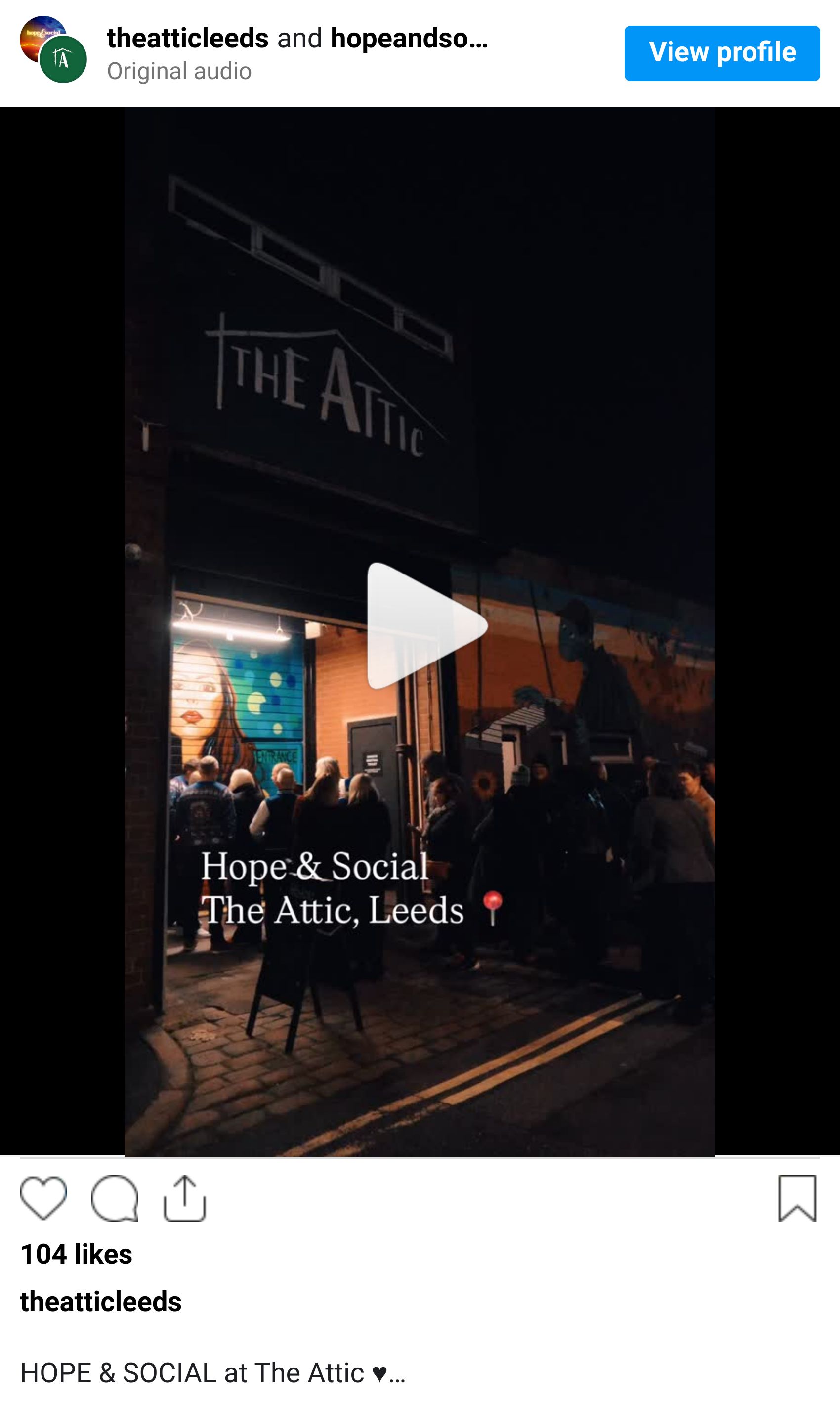
RH: We've got a relationship with a wonderful venue in Leeds called The Attic, and this year we decided to try and do one a month. We've had a couple where we've been on tour. But, essentially, each month is different. So I think the first one was all acoustic instruments. I think the second one was all the keyboards we own, everything from your little Casio right through to James's multi-thousand pound modular Moog rig.
RH: We did one where I wasn't there, and that was all toy instruments, and we've done some with, like, a massive extended 8-piece brass section.
RH: We did one at the end of the school year, so that became a school assembly, almost, we're in the middle on the floor, and we get people up on stage, and they do their performance, which they learn there and then.
RH: Things like that. So, we're gonna be doing a bunch of those through the new year. We've got one in every month from January until June?
JA: New records or anything?
RH: so we've started working at a great place in Wales, and so we've done two… I think two weeks' worth of writing and recording there already and we probably need another week or two … maybe we've had three weeks, actually. We probably need, like, another week or two just to finish that off, but I think we're gonna do that probably locally. So we can dip in and out a little bit. Whereas, when it's in Wales, we're there for the duration, which is great. Iit's an awesome place. In fact, it's so good, I'm not even gonna say the name of it, because I don't want anyone booking it up.
RH: So yeah, we will have a new record out next year, but it will be for our September, October tour, which is in… which is in the month. We're also trying to work out a way that we can do a concerted block of festivals this weekend, and, you know, try and really you know, even as a loss leader, just be like, hey, we want to play your festival. We normally charge this much, tell us what you can pay, we wanna be there, and see if we can get in front of, you know, new people. We still want to, you know, meet new people. Get in front of new potential fans, like we love the ones we've got, but let's have a few more.
JA: Cool, alright, fabulous. Well, it's been lovely to talk to you.
RH: Same
JA: Thank you very much.

@sellyourartdotblog Get your unique, buyer-attracting Hook Intensive at sellyourart.blog , use it, enjoy the difference
An AI generated list of aggregators of funding sources
(Let me know if you think anything needs changing)
Table
Platform | What It Does | Limitations |
|---|---|---|
Res Artis | Database of 500+ residencies worldwide | Institutionally-hosted residencies; rarely artist-run spaces |
NYFA Source (NY Foundation for the Arts) | Comprehensive grants, jobs, housing, residencies | US-heavy; mostly formal funding streams |
CaFÉ (Call for Entry) | Museums, nonprofits, public art programs | Requires subscription; institutional bias |
EntryThingy | Submission management for galleries | Gallery-focused; fees common |
Artwork Archive Calls for Entry | Filterable database by type, location, deadline | Mix of commercial and nonprofit; quality varies |
Art Rabbit | UK/EU opportunities, commissions, exhibitions | Better for mid-career; less grassroots |
A-N Artists Newsletter (UK) | Jobs, commissions, open calls | Behind paywall for full access |
Arts Jobs (Arts Council England) | Weekly listings across disciplines | Formal sector focus |
Art Guide | Direct-to-organizer applications | Updated daily but variable quality |
Artist Trust (Pacific Northwest US) | Regional funding, housing, residencies | Geographic limitation |
Submittable | Platform used by many organizations | Not a database—just a submission tool |
Only For Artists (Substack) | Curated international opportunities | Better for deadlines than grassroots news |
Art Meets Culture (Substack) | Trend analysis, some opportunities | More commentary than listings |
Specialized/Niche Aggregators
BOMB Magazine — Fellowships and residencies
WomenArts — Funding for women artists
Creative Capital — Forward-thinking project grants
CERF+ — Emergency relief for craft artists
Springboard for the Arts (Minnesota) — Mutual aid resources, emergency funds
MOCA Tucson Night Bloom — Artist-led community projects, mutual aid arts initiatives
Art to Change the World — "SWAP + Barter" bulletin for trading goods/services
